Chapter 4: Describing Motion Around Us
🔹 1. What is Motion?
- An object is said to be in motion if it changes its position with respect to time and surroundings.
- Example: A moving car, flying bird
🔹 2. What is Rest?
- An object is at rest if its position does not change with respect to time and surroundings.
- Rest and motion are relative terms
Motion in a Straight Line (Rectilinear Motion)
- Motion in a straight line is called rectilinear motion.
- In this type of motion, an object moves along a straight path.
Examples
- A car moving on a straight road
- A train moving on a straight track
- A person walking in a straight line
Important Terms
| Term | Meaning |
|---|
| Distance | Total path covered by an object |
| Displacement | Shortest distance between initial and final position |
| Speed | Distance travelled per unit time |
| Velocity | Displacement per unit time in a given direction |
| Acceleration | Rate of change of velocity |
🔹 3. Types of Motion
Rectilinear Motion
- Motion in a straight line
- Example: Train on straight track
Circular Motion
- Motion along a circular path
- Example: Clock hands, Earth around Sun
Periodic Motion
- Motion repeated at regular intervals
- Example: Swing, pendulum
Random Motion
- No fixed path
👉 Example: Dust particles in air
Types of Motion
| Type of Motion | Meaning | Example |
|---|
| Rectilinear Motion | Motion in a straight line | A car moving on a straight road |
| Circular Motion | Motion along a circular path | Hands of a clock |
| Rotational Motion | Motion around an axis | Earth rotating on its axis |
| Periodic Motion | Motion repeated at regular intervals | Pendulum of a clock |
| Oscillatory Motion | To and fro motion about a mean position | Swing moving back and forth |
| Random Motion | Motion without a fixed path | Movement of insects |
| Uniform Motion | Object covers equal distances in equal intervals of time | Train moving at constant speed |
| Non-uniform Motion | Object covers unequal distances in equal intervals of time | Bus moving in traffic |
4. Distance and Displacement
Distance
- Total path covered by an object
- Scalar quantity (only magnitude)
- SI unit meter (m)
Displacement
- Shortest straight-line distance between initial and final position
- Vector quantity (magnitude + direction)
- SI unit meter (m)
Key Difference:
- Distance ≥ Displacement always
Difference Between Distance and Displacement
| Basis | Distance | Displacement |
|---|
| Meaning | Total path travelled by an object | Shortest path between initial and final position |
| Type of Quantity | Scalar quantity | Vector quantity |
| Direction | No direction | Has direction |
| Value | Always positive | Can be positive, negative, or zero |
| Depends On | Actual path travelled | Initial and final positions only |
| Example | Walking around a park | Straight line from start to end point |
🔹 5. Speed
Speed
- Speed is the distance travelled by an object in a unit time.
- speed is scalar quantity
- SI unit : metre per second (m/s)
- Example A car moving at 60 km/h,
Formula of Speed
Where:
- Distance = Total path travelled
- Time = Time taken to travel
6. Types of Speed
| Type of Speed | Meaning |
|---|
| Uniform Speed | Equal distances covered in equal intervals of time |
| Non-uniform Speed | Unequal distances covered in equal intervals of time |
| Average Speed | Total distance ÷ Total time |
| Instantaneous Speed | Speed at a particular instant |
🔹 7. Velocity
- Velocity is the rate of change of displacement with respect to time.
- In simple words, it is the speed in a given direction.
- metre per second (m/s)
- vector quantity
- it can be +ve, -ve or zero
Formula of Velocity
Where:
- Displacement = Shortest distance in a particular direction
- Time = Time taken
Types of Velocity
| Type | Meaning |
|---|
| Uniform Velocity | Constant speed in a fixed direction |
| Non-uniform Velocity | Changes in speed or direction |
| Average Velocity | Total displacement ÷ total time |
Example
- A car moving 10 m east in 2 seconds has velocity = 5 m/s east
- If direction changes, velocity also changes even if speed is same
Difference Between Speed and Velocity
| Basis | Speed | Velocity |
|---|
| Meaning | Distance travelled per unit time | Displacement per unit time in a given direction |
| Nature | Scalar quantity | Vector quantity |
| Direction | No direction | Has direction |
| Depends on | Distance | Displacement |
| Can be negative? | No | Yes (depends on direction) |
| Change in direction | Does not affect speed | Affects velocity |
| Formula | | |
| Example | A car moving at 40 km/h | A car moving 40 km/h north |
🔹 8. Acceleration
- Acceleration is the rate of change of velocity of an object with respect to time.
- It tells us how quickly the velocity of an object is increasing or decreasing.
- SI Unit of Acceleration : metre per second squared (m/s²)
- Acceleration is a vector quantity (has direction).
- It can be positive, negative, or zero.
- Zero acceleration means velocity is constant.
- Example : A bike increases its speed from 0 m/s to 20 m/s in 5 seconds, it is accelerating.
Formula of Acceleration
Where:
- a = acceleration
- v = final velocity
- u = initial velocity
- t = time taken
Types of Acceleration
| Type | Meaning | Example |
|---|
| Positive Acceleration | Velocity increases with time | A car speeding up |
| Negative Acceleration (Retardation/Deceleration) | Velocity decreases with time | A moving car applying brakes |
| Uniform Acceleration | Equal change in velocity in equal time intervals | Freely falling object (ideal case) |
| Average acceleration | change in velocity divided by time interval | used when acceleration is not constant |
🔹 9. Graphical Representation of Motion
Position -Time Graph
- Straight line → uniform motion
- Curved line → non-uniform motion
- A position–time graph shows how the position of an object changes with time.
- It helps us understand the motion of an object easily.
- X-axis (horizontal) → Time (t), Y-axis (vertical) → Position (distance or displacement)
- slope = speed (distance time graph)
- slope = velocity (displacement time graph)
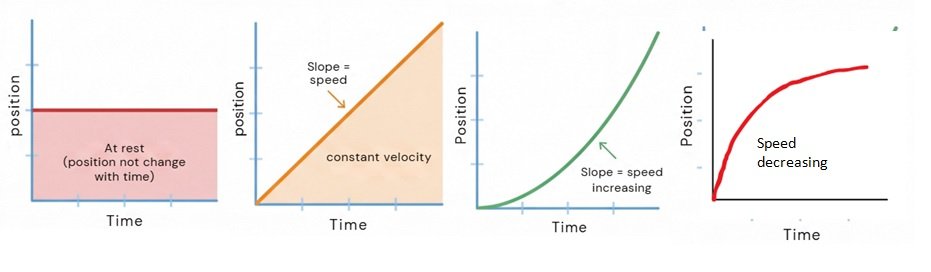 position time graph
Position–Time Graph Comparison (Tab Form)
| Case | Nature of Motion | Shape of Graph | Speed | Example |
|---|
| Object at Rest | No motion | Straight horizontal line | Zero | Book kept on table |
| Uniform Motion | Constant speed | Straight slanting line | Constant | Car moving at steady speed |
| Non-uniform Motion | Changing speed | Curved line | Changing | Bus in traffic |
| Acceleration (speeding up) | Speed increases with time | Curve becoming steeper | Increasing | Bicycle speeding up |
| Deceleration (slowing down) | Speed decreases with time | Curve becoming less steep | Decreasing | Car applying brakes |
📊 Velocity-Time Graph
- A velocity–time graph shows the change in velocity with time.
- Time is shown on the X-axis.
- Velocity is shown on the Y-axis.
- The slope of the graph gives acceleration.
- Types of Velocity–Time Graphs
- Constant Velocity → Horizontal straight line
- Increasing Velocity → Upward sloping line
- Decreasing Velocity → Downward sloping line
- Area under velocity-time graph = displacement
- Area under speed-time graph = distance
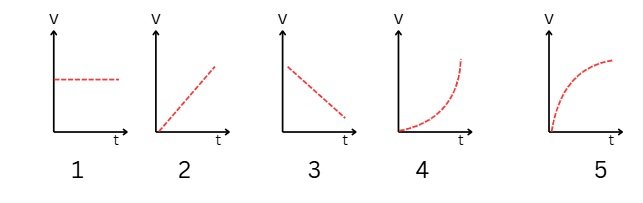 velocity time graph
- Constant Velocity – Acceleration = zero
- Uniform Acceleration – Acceleration is in the direction of velocity
- Uniform Retardation – Acceleration is in the opposite direction of velocity
- Non-Uniform Acceleration – Acceleration increasing
- Non-Uniform Acceleration – Acceleration decreasing
🔹 10. Uniform Motion vs Non-uniform Motion
| Uniform Motion | Non-uniform Motion |
|---|
| Equal speed | Changing speed |
| Constant velocity | Variable velocity |
🔹 11. Equations of Motion or kinematic equations
- These equation is only applicable when acceleration is constant.
- v = u + at
- s = ut + ½at²
- v² = u² + 2as
Where:
u = initial velocity
v = final velocity
a = acceleration
s = distance
🔹 12. Types of Motion
| Type of Motion | Meaning | Dimensions Involved | Example |
|---|
| 1D Motion | Motion along a straight line | One dimension | Train on a straight track |
| 2D Motion | Motion in a plane | Two dimensions | Throwing a ball |
| 3D Motion | Motion in space | Three dimensions | Flying airplane |
13. Uniform Circular Motion
- Motion of an object in a circular path with constant speed
- Ex.- Satellite around Earth, stone tied to a string, fan blades
- Characteristics :
- Speed remains constant,
- but direction keeps changing;
- due to changing direction velocity is not constant;
- so acceleration is present towards the center (centripetal acceleration)
- direction of velocity-tangent at that point
- Formula for centripetal acceleration :
-
- Where:
- ac = centripetal acceleration
- v = speed of object
- r = radius of circular path
| Quantity | Formula | Meaning |
|---|
| Average speed in circular motion | = circumference / time | Distance per time |
| Average velocity (1 full round) | 0 | Displacement per time |
14. Comparision of Graphs
| Property | Distance–Time Graph | Displacement–Time Graph | Speed–Time Graph | Velocity–Time Graph |
|---|
| Slope of graph | Speed | Velocity | Acceleration | Acceleration |
| Area under graph | No physical significance | No physical significance | Distance travelled | Displacement |
| Horizontal line | Object at rest | Object at rest | Constant speed | Constant velocity |
| Positive slope | Distance increasing | Positive velocity | Positive acceleration | Positive acceleration |
| Negative slope | Not possible | Negative velocity | Negative acceleration (retardation) | Negative acceleration |
| Zero slope | Object at rest | Object at rest | Zero acceleration (constant speed) | Zero acceleration (constant velocity) |
| Steeper slope | Greater speed | Greater velocity | Greater acceleration | Greater acceleration |
| Can graph lie below X-axis? | No | Yes | No | Yes |
| Quantity obtained from slope | Speed | Velocity | Acceleration | Acceleration |
| Quantity obtained from area | None | None | Distance | Displacement |
Chapter 4: Describing Motion Around Us — MCQs (1–120)
🔹 Basic Concepts of Motion (1–30)
- Motion is defined as: A. change in shape B. change in position C. change in mass D. change in color
- Rest means: A. no change in position B. moving fast C. circular motion D. acceleration
- Motion is always measured with respect to: A. time B. reference point C. speed D. force
- Rest and motion are: A. absolute B. relative C. fixed D. constant
- Example of motion: A. tree B. moving car C. stone D. wall
- Example of rest: A. flying bird B. parked car C. running train D. flowing river
- Motion in straight line is called: A. circular B. rectilinear C. periodic D. random
- Motion along circular path is: A. rectilinear B. circular C. random D. oscillatory
- Repeated motion is: A. circular B. periodic C. rectilinear D. random
- Dust particles show: A. rectilinear B. random C. circular D. periodic motion
- SI unit of distance is: A. km B. m C. cm D. mm
- Distance is a: A. vector B. scalar C. force D. velocity
- Displacement is a: A. scalar B. vector C. mass D. time
- Distance is always: A. less than displacement B. equal or greater than displacement C. negative D. zero
- Displacement depends on: A. path B. direction C. time only D. mass
- Distance depends on: A. shortest path B. actual path C. direction D. force
- SI unit of displacement is: A. m B. km C. cm D. mm
- Zero displacement means: A. object moved B. no change in position C. fast motion D. circular motion
- Distance covered is always: A. zero B. positive C. negative D. vector
- Displacement can be: A. only positive B. positive or negative C. only zero D. only scalar
- Motion in a pendulum is: A. random B. periodic C. circular D. rectilinear
- Earth revolving around sun is: A. random B. circular C. rectilinear D. oscillatory
- A moving train on straight track shows: A. circular motion B. rectilinear motion C. random motion D. periodic motion
- A moving fan blade shows: A. rectilinear B. circular C. random D. oscillatory
- SI unit of time is: A. minute B. hour C. second D. day
- Motion of a ceiling fan is: A. random B. circular C. rectilinear D. periodic only
- A body is at rest if: A. moving fast B. position unchanged C. accelerating D. rotating
- Motion depends on: A. color B. reference point C. shape D. size
- A moving object may appear at rest to: A. all observers B. moving observer C. fixed observer D. none
- Reference point is also called: A. origin B. motion point C. rest point D. speed point
🔹 Speed, Velocity & Acceleration (31–70)
- Speed = A. distance/time B. displacement/time C. force/time D. mass/time
- Velocity = A. distance/time B. displacement/time C. speed×time D. force/mass
- Speed is a: A. vector B. scalar C. force D. displacement
- Velocity is a: A. scalar B. vector C. mass D. energy
- SI unit of speed is: A. m/s B. m²/s C. kg/m D. N
- Uniform speed means: A. changing speed B. constant speed C. zero speed D. negative speed
- Non-uniform speed means: A. constant speed B. changing speed C. zero motion D. circular motion only
- Acceleration = A. speed/time B. change in velocity/time C. distance/time D. force/time
- SI unit of acceleration: A. m/s B. m/s² C. km/s D. N/m
- Positive acceleration means: A. speed decreases B. speed increases C. no motion D. circular motion
- Negative acceleration is called: A. velocity B. deceleration C. speed D. force
- If velocity is constant, acceleration is: A. zero B. infinite C. negative D. positive
- Speed depends on: A. distance & time B. mass C. force D. shape
- Velocity depends on: A. direction B. color C. weight D. size
- Displacement/time gives: A. speed B. velocity C. force D. mass
- Distance/time gives: A. velocity B. speed C. acceleration D. force
- Acceleration occurs when: A. velocity changes B. mass changes C. time stops D. distance is zero
- A body moving in circle has: A. constant velocity B. changing velocity C. zero velocity D. constant speed only
- Uniform motion means: A. changing speed B. equal distance in equal time C. no motion D. circular motion
- Non-uniform motion means: A. equal distance B. unequal speed C. no motion D. rest
- Velocity can be: A. only positive B. positive or negative C. only zero D. only scalar
- Speed is always: A. negative B. positive C. zero only D. vector
- Acceleration can be: A. only positive B. positive or negative C. only zero D. scalar only
- Retardation means: A. increase in speed B. decrease in speed C. no motion D. circular motion
- Motion of car in traffic is: A. uniform B. non-uniform C. no motion D. circular
- A freely falling body has: A. zero acceleration B. constant acceleration C. variable speed only D. no motion
- Gravity produces: A. no motion B. acceleration C. rest D. force only
- SI unit of velocity is: A. m/s B. m/s² C. km² D. N
- Speedometer measures: A. acceleration B. speed C. force D. distance
- Odometer measures: A. speed B. distance C. force D. velocity
- Acceleration is change in: A. distance B. velocity C. force D. mass
- Negative acceleration reduces: A. mass B. speed C. time D. distance
- If object is at rest, speed is: A. 1 B. 0 C. infinite D. negative
- Circular motion has: A. constant velocity B. changing direction C. no motion D. no speed
- Velocity is defined with: A. only magnitude B. magnitude and direction C. only time D. only distance
- Speed is always: A. vector B. scalar C. force D. acceleration
- Acceleration depends on: A. velocity change B. mass only C. force only D. distance only
- Motion in a straight line is: A. circular B. rectilinear C. random D. periodic
- Speed is independent of: A. distance B. direction C. time D. magnitude
- Velocity changes if: A. direction changes B. mass changes C. time stops D. distance is zero
🔹 Graphs & Advanced Concepts (71–120)
- Distance-time graph slope gives: A. speed B. force C. mass D. acceleration
- Velocity-time graph slope gives: A. speed B. acceleration C. distance D. mass
- Area under velocity-time graph gives: A. acceleration B. displacement C. speed D. force
- Straight line in distance-time graph shows: A. rest B. uniform motion C. acceleration D. circular motion
- Curved graph shows: A. uniform motion B. non-uniform motion C. rest D. zero speed
- Flat line in distance-time graph means: A. motion B. rest C. acceleration D. velocity
- Slope in graph represents: A. direction B. rate of change C. mass D. force
- Distance-time graph for rest is: A. straight slant B. horizontal line C. curve D. circle
- Velocity-time graph for uniform motion is: A. curve B. straight horizontal line C. zigzag D. circle
- Acceleration is zero when velocity is: A. changing B. constant C. negative D. zero only
- Motion can be described using: A. graphs B. colors C. smell D. taste
- Motion in space is relative to: A. object B. reference point C. force D. mass
- Displacement can be zero even if distance is: A. zero B. non-zero C. negative D. infinite
- Round trip displacement is: A. zero B. distance C. speed D. acceleration
- Speed has no: A. magnitude B. direction C. time D. unit
- Velocity has: A. no direction B. direction C. no time D. no magnitude
- Acceleration is rate of change of: A. speed B. velocity C. distance D. mass
- A car moving in circle has: A. constant velocity B. changing direction C. no speed D. rest
- Motion of Earth is: A. random B. circular C. rectilinear D. stationary
- Motion of pendulum is: A. random B. periodic C. circular D. straight
- Uniform motion graph is: A. curve B. straight line C. circle D. zigzag
- Non-uniform motion graph is: A. straight B. curve C. flat D. horizontal
- Acceleration is zero when: A. velocity changes B. velocity constant C. distance changes D. force applied
- Velocity is zero when object is: A. moving B. at rest C. accelerating D. rotating
- Distance-time graph slope is: A. velocity B. speed C. acceleration D. force
- Motion in zigzag path is: A. rectilinear B. random C. circular D. periodic
- A moving fan shows: A. rectilinear B. circular C. random D. straight
- SI unit of acceleration is derived from: A. speed B. velocity/time C. force D. mass
- Motion depends on: A. observer B. color C. weight D. size
- Speed is ratio of: A. time/distance B. distance/time C. force/mass D. velocity/time
- Velocity is ratio of: A. displacement/time B. distance/time C. force/time D. mass/time
- Acceleration increases when: A. velocity changes faster B. time increases C. distance decreases D. mass decreases
- Motion of bicycle is: A. uniform always B. non-uniform mostly C. circular D. rest
- Graph shows motion in: A. numbers B. visual form C. sound D. smell
- Slope indicates: A. direction B. steepness C. mass D. force
- Faster motion has: A. low speed B. high speed C. zero speed D. negative speed
- Slower motion has: A. high speed B. low speed C. zero time D. no distance
- Rest means: A. motion B. no motion C. acceleration D. force
- Motion of planets is: A. random B. circular C. straight D. no motion
- Speed is measured by: A. thermometer B. speedometer C. barometer D. ammeter
- Distance cannot be: A. zero B. negative C. positive D. large
- Displacement can be: A. negative B. positive or negative C. zero only D. none
- Motion is always relative to: A. sun B. observer C. earth D. air
- Graph helps to understand: A. smell B. motion C. color D. sound
- Acceleration is zero in: A. uniform motion B. rest C. both A and B D. circular motion
- Uniform speed means: A. changing B. constant C. zero D. random
- Velocity includes: A. only magnitude B. magnitude and direction C. only direction D. none
- Motion of train is: A. always uniform B. often non-uniform C. circular D. random
- Free falling object has: A. zero acceleration B. constant acceleration C. no motion D. random motion
- Displacement is: A. scalar B. vector C. force D. mass
Answer Key (1–120)
| Q | A | Q | A | Q | A | Q | A | Q | A |
|---|
| 1 | B | 21 | B | 41 | B | 61 | B | 81 | B |
| 2 | B | 22 | B | 42 | A | 62 | B | 82 | B |
| 3 | B | 23 | B | 43 | A | 63 | B | 83 | B |
| 4 | B | 24 | B | 44 | A | 64 | B | 84 | A |
| 5 | B | 25 | C | 45 | B | 65 | B | 85 | B |
| 6 | B | 26 | B | 46 | B | 66 | B | 86 | B |
| 7 | B | 27 | B | 47 | A | 67 | A | 87 | B |
| 8 | B | 28 | B | 48 | B | 68 | B | 88 | B |
| 9 | B | 29 | B | 49 | B | 69 | B | 89 | B |
| 10 | B | 30 | A | 50 | B | 70 | A | 90 | B |
| 11 | B | 31 | B | 51 | B | 71 | B | 91 | B |
| 12 | B | 32 | B | 52 | B | 72 | B | 92 | B |
| 13 | B | 33 | B | 53 | B | 73 | B | 93 | B |
| 14 | B | 34 | B | 54 | B | 74 | B | 94 | B |
| 15 | B | 35 | B | 55 | B | 75 | B | 95 | A |
| 16 | B | 36 | B | 56 | B | 76 | B | 96 | B |
| 17 | B | 37 | B | 57 | B | 77 | B | 97 | B |
| 18 | B | 38 | B | 58 | A | 78 | B | 98 | B |
| 19 | B | 39 | B | 59 | B | 79 | C | 99 | A |
| 20 | B | 40 | B | 60 | B | 80 | B | 100 | C |
Graph-Based MCQs (1–50)
🔹 Distance–Time Graph (1–25)
- Slope of distance–time graph gives: A. acceleration B. speed C. force D. mass
- A straight line in distance–time graph shows: A. rest B. uniform motion C. acceleration D. random motion
- A horizontal line in distance–time graph shows: A. motion B. rest C. acceleration D. velocity
- Curved distance–time graph shows: A. uniform motion B. non-uniform motion C. rest D. zero speed
- Steeper slope means: A. slow speed B. high speed C. no speed D. rest
- Less steep slope means: A. higher speed B. lower speed C. no motion D. acceleration
- Distance–time graph cannot be: A. straight B. curved C. horizontal D. circular
- If distance increases uniformly, graph is: A. curve B. straight line C. zigzag D. circle
- If object is at rest, graph is: A. upward line B. horizontal line C. curve D. slope
- Distance-time graph is always: A. straight B. graphical representation C. force diagram D. vector
- Uniform motion is shown by: A. curved line B. straight line C. circle D. zigzag
- Non-uniform motion is shown by: A. straight line B. curved line C. horizontal line D. no graph
- Slope of graph represents: A. mass B. speed C. force D. time
- If slope is zero, object is: A. moving fast B. at rest C. accelerating D. rotating
- Equal distance in equal time gives: A. curved graph B. straight line C. no graph D. circle
- Distance-time graph shows relation between: A. speed & force B. distance & time C. mass & velocity D. force & time
- Graph for constant speed is: A. curve B. straight line C. zigzag D. circle
- Increasing slope means: A. decreasing speed B. increasing speed C. no speed D. rest
- Decreasing slope means: A. acceleration B. deceleration C. rest D. uniform motion
- Horizontal line means: A. motion B. rest C. acceleration D. force
- A graph with changing slope shows: A. uniform motion B. non-uniform motion C. rest D. no time
- Distance-time graph is plotted with: A. time on x-axis B. distance on x-axis C. force on x-axis D. mass on x-axis
- Distance is plotted on: A. x-axis B. y-axis C. both D. none
- Time is plotted on: A. x-axis B. y-axis C. both D. none
- Straight line graph indicates: A. changing speed B. constant speed C. no motion D. circular motion
🔹 Velocity–Time Graph (26–50)
- Slope of velocity-time graph gives: A. speed B. acceleration C. force D. mass
- Area under velocity-time graph gives: A. acceleration B. displacement C. speed D. force
- Straight horizontal line in v–t graph shows: A. acceleration B. uniform velocity C. rest D. force
- Rising line in v–t graph shows: A. deceleration B. acceleration C. rest D. constant speed
- Falling line in v–t graph shows: A. acceleration B. deceleration C. rest D. force
- Zero slope in v–t graph means: A. acceleration B. no acceleration C. force D. mass
- Curved v–t graph shows: A. uniform motion B. non-uniform acceleration C. rest D. no motion
- Velocity-time graph is used to find: A. force B. acceleration C. color D. mass
- Uniform velocity is shown by: A. curved line B. horizontal straight line C. circle D. zigzag
- Acceleration increases when slope: A. decreases B. increases C. becomes zero D. negative
- Deceleration is shown by: A. rising graph B. falling graph C. horizontal graph D. circle
- Area under graph represents: A. speed B. displacement C. force D. mass
- Velocity-time graph axes are: A. distance-time B. velocity-time C. force-time D. mass-time
- Time is always on: A. y-axis B. x-axis C. both D. none
- Velocity is on: A. x-axis B. y-axis C. both D. none
- Constant acceleration graph is: A. straight line B. curve C. horizontal D. zigzag
- Zero velocity means graph lies on: A. x-axis B. y-axis C. curve D. slope
- Increasing velocity shows: A. downward slope B. upward slope C. horizontal line D. circle
- Decreasing velocity shows: A. upward slope B. downward slope C. horizontal D. no graph
- Flat v–t graph means: A. acceleration B. constant velocity C. rest D. force
- Steep slope in v–t graph means: A. low acceleration B. high acceleration C. rest D. zero speed
- Velocity-time graph is also called: A. motion graph B. speed graph C. force graph D. mass graph
- Acceleration is: A. slope of distance graph B. slope of velocity graph C. area under distance graph D. none
- Displacement from graph is: A. slope B. area under curve C. height D. width
- Motion graphs help to study: A. force only B. motion behavior C. color change D. mass only
Answer Key (Graph-based MCQs 1–50)
| Q | A | Q | A | Q | A | Q | A | Q | A |
|---|
| 1 | B | 11 | B | 21 | B | 31 | B | 41 | A |
| 2 | B | 12 | B | 22 | A | 32 | B | 42 | A |
| 3 | B | 13 | B | 23 | B | 33 | B | 43 | B |
| 4 | B | 14 | B | 24 | A | 34 | B | 44 | B |
| 5 | B | 15 | B | 25 | B | 35 | B | 45 | B |
| 6 | B | 16 | B | 26 | B | 36 | B | 46 | B |
| 7 | D | 17 | B | 27 | B | 37 | B | 47 | A |
| 8 | B | 18 | B | 28 | B | 38 | B | 48 | B |
| 9 | B | 19 | B | 29 | B | 39 | B | 49 | B |
| 10 | B | 20 | B | 30 | B | 40 | B | 50 | B |