Osmosis is the movement of water molecules across a selectively (semi-) permeable membrane from an area where there is more water (lower solute concentration) to an area where there is less water (higher solute concentration) until equilibrium is reached.
Simple example
Imagine a membrane separating two solutions:
- Side A: Pure water
- Side B: Salt water
The membrane allows water to pass through but not salt.
Water moves from Side A → Side B because Side B has a higher concentration of dissolved salt (solute) and therefore a lower concentration of free water molecules.
Key points
- Only water moves (or mainly water), not the dissolved solute.
- A selectively permeable membrane is required.
- Osmosis is a passive process, meaning it does not require energy (ATP).
In living cells
Osmosis helps cells maintain the right amount of water.
- Hypotonic solution (less solute outside): Water enters the cell, causing it to swell. Plant cells become firm (turgid), while animal cells may burst if too much water enters.
- Hypertonic solution (more solute outside): Water leaves the cell, causing it to shrink.
- Isotonic solution (equal solute concentration): Water moves in and out at equal rates, so there is no net change in cell size.
Everyday examples
- Plant roots absorb water from the soil through osmosis.
- Raisins swell when soaked in water.
- Vegetables become crisp after being placed in water.
- Gargling with salt water can draw water out of swollen tissues.
Easy way to remember
Osmosis = movement of water through a selectively permeable membrane from low solute concentration to high solute concentration.
Diffusion: Movement of particles from higher concentration to lower concentration. It may occur with or without a membrane.
Osmosis: Movement of water only from lower solute concentration to higher solute concentration through a selectively permeable membrane.
Why is the membrane necessary?
The membrane is selective:
- It allows water molecules to pass.
- It prevents some or all solute particles (such as salt or sugar) from crossing.
Because the solute cannot move freely, water moves instead to reduce the concentration difference.
What if there is no membrane?
If you pour water into a beaker containing a salt solution with no membrane separating them, the water and salt mix by diffusion (and bulk mixing), not osmosis.
Easy rule for exams
- ✅ Diffusion → Membrane not required.
- ✅ Osmosis → Selectively permeable membrane is essential.
| Diffusion | Osmosis |
|---|---|
| Movement of any particles (molecules or ions). | Movement of water molecules only. |
| Occurs from higher concentration to lower concentration of the particles. | Water moves from lower solute concentration (higher water concentration) to higher solute concentration (lower water concentration). |
| No membrane is required, although it can occur across one. | A selectively (semi-) permeable membrane is essential. |
| Occurs in gases, liquids, and solids. | Occurs only in liquid solutions involving water. |
| Example: Perfume smell spreading through a room. | Example: Plant roots absorbing water from the soil. |
Easy way to remember
- Diffusion = Any particles move.
- Osmosis = Only water moves.
- Diffusion = Membrane not necessary.
- Osmosis = Selectively permeable membrane required.
One-line definitions for exams
- Diffusion: The movement of particles from a region of higher concentration to a region of lower concentration until equilibrium is reached.
- Osmosis: The movement of water molecules through a selectively permeable membrane from a region of lower solute concentration to a region of higher solute concentration until equilibrium is reached.
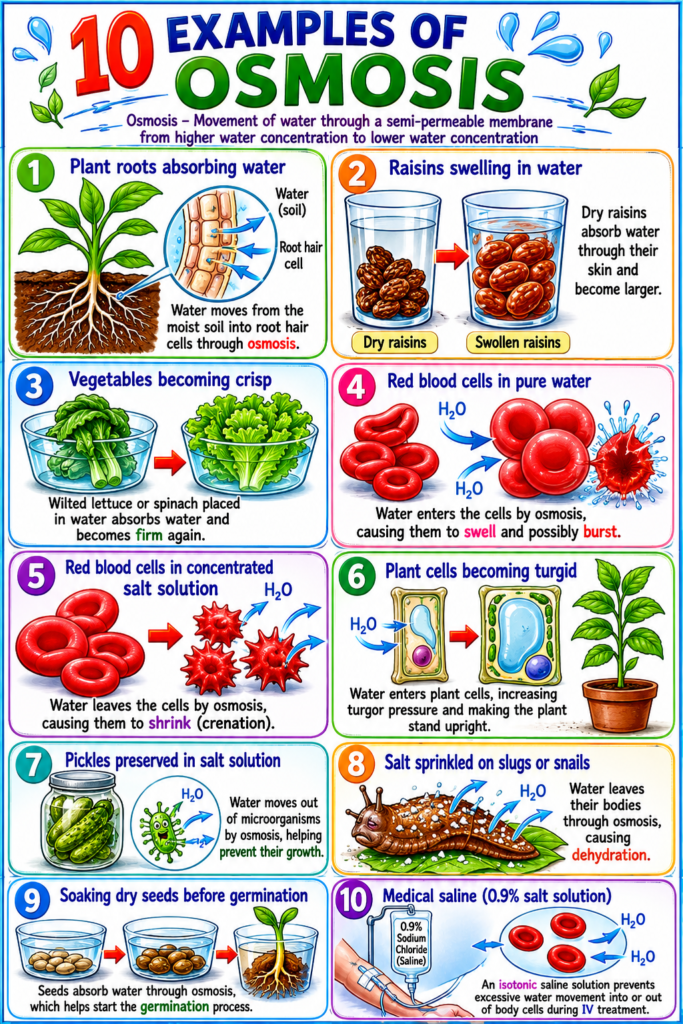
10 common examples of osmosis
- Plant roots absorbing water
- Water moves from the moist soil into root hair cells through osmosis.
- Raisins swelling in water
- Dry raisins absorb water through their skin and become larger.
- Vegetables becoming crisp
- Wilted lettuce or spinach placed in water absorbs water and becomes firm again.
- Red blood cells in pure water
- Water enters the cells by osmosis, causing them to swell and possibly burst.
- Red blood cells in concentrated salt solution
- Water leaves the cells by osmosis, causing them to shrink (crenation).
- Plant cells becoming turgid
- Water enters plant cells, increasing turgor pressure and making the plant stand upright.
- Pickles preserved in salt solution
- Water moves out of microorganisms by osmosis, helping prevent their growth.
- Salt sprinkled on slugs or snails
- Water leaves their bodies through osmosis, causing dehydration.
- Soaking dry seeds before germination
- Seeds absorb water through osmosis, which helps start the germination process.
- Medical saline (0.9% salt solution)
- An isotonic saline solution prevents excessive water movement into or out of body cells during intravenous (IV) treatment.
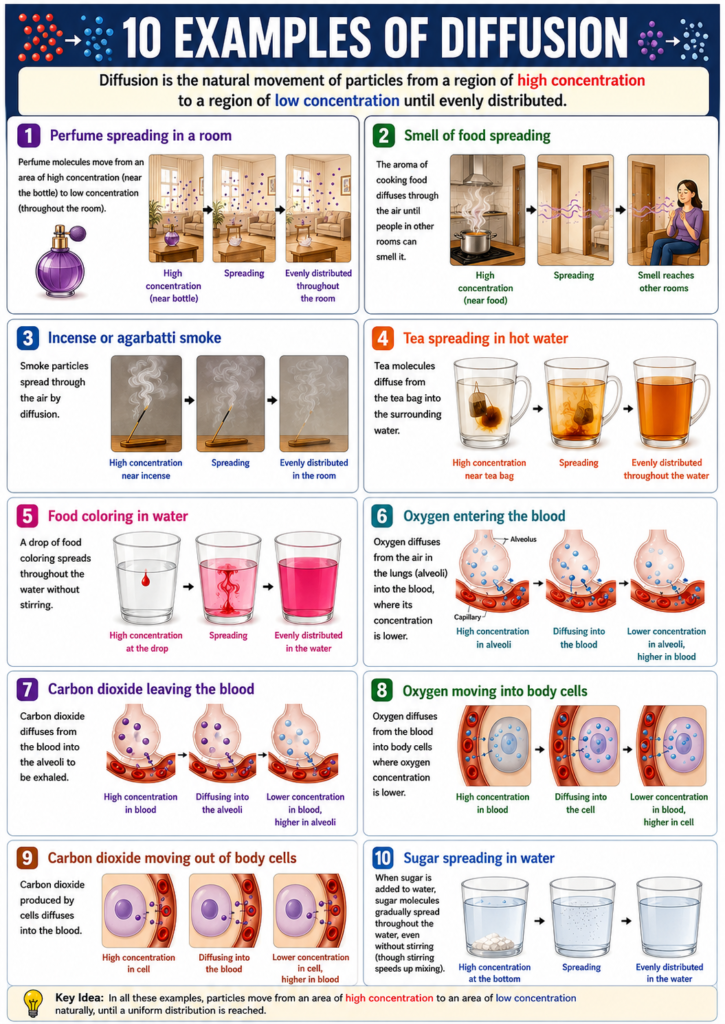
10 common examples of diffusion from daily life and biology.
1. Perfume spreading in a room
- Perfume molecules move from an area of high concentration (near the bottle) to low concentration (throughout the room).
2. Smell of food spreading
- The aroma of cooking food diffuses through the air until people in other rooms can smell it.
3. Incense or agarbatti smoke
- Smoke particles spread through the air by diffusion.
4. Tea spreading in hot water
- Tea molecules diffuse from the tea bag into the surrounding water.
5. Food coloring in water
- A drop of food coloring spreads throughout the water without stirring.
6. Oxygen entering the blood
- Oxygen diffuses from the air in the lungs (alveoli) into the blood, where its concentration is lower.
7. Carbon dioxide leaving the blood
- Carbon dioxide diffuses from the blood into the alveoli to be exhaled.
8. Oxygen moving into body cells
- Oxygen diffuses from the blood into body cells where oxygen concentration is lower.
9. Carbon dioxide moving out of body cells
- Carbon dioxide produced by cells diffuses into the blood.
10. Sugar spreading in water
- When sugar is added to water, sugar molecules gradually spread throughout the water, even without stirring (though stirring speeds up mixing).
| Diffusion | Osmosis |
|---|---|
| Any particles (gas, liquid, or solute) move. | Only water molecules move. |
| Membrane not necessary. | Requires a selectively permeable membrane. |
| Example: Perfume spreading in air. | Example: Raisins swelling in water. |
A simple memory trick is:
- Diffusion = “Anything diffuses.”
- Osmosis = “Only water through a selectively permeable membrane.”