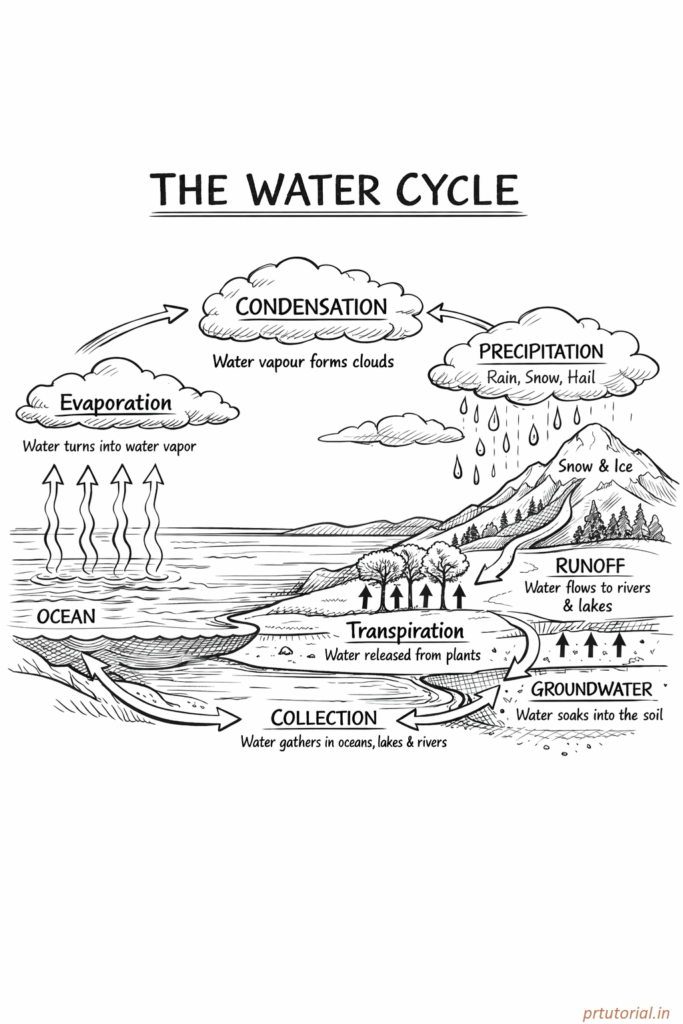
The Water Cycle: Nature’s Amazing Recycling System
Water is essential for all life on Earth, and it never stays in one place for long. It is constantly moving through a natural process called the water cycle. This cycle ensures that water is recycled and reused over and over again, supporting life, weather, and the environment.
Key Stages of the Water Cycle
- Evaporation
Water from oceans, rivers, lakes, and even soil heats up from the sun’s energy and turns into water vapor. This vapor rises into the atmosphere, leaving behind impurities and forming invisible moisture in the air. - Transpiration
Plants also play a role in the water cycle. They release water vapor from their leaves into the air, a process called transpiration. Together with evaporation, this stage is sometimes referred to as evapotranspiration. - Condensation
As water vapor rises, it cools and changes back into tiny water droplets. These droplets gather to form clouds or fog, creating visible water in the atmosphere. - Precipitation
When clouds become heavy, water falls back to the Earth as rain, snow, sleet, or hail. This step is called precipitation and is essential for replenishing water in rivers, lakes, and soil. - Collection
After precipitation, water collects in rivers, lakes, oceans, or infiltrates into the ground to become groundwater. From here, the cycle begins again with evaporation.
Why the Water Cycle Matters
- Supports Life: Provides fresh water for drinking, agriculture, and ecosystems.
- Regulates Climate: Moves heat and moisture around the planet, affecting weather patterns.
- Cleans Water: Natural filtration through evaporation and infiltration helps purify water.
The water cycle is a continuous, never-ending journey of water. Understanding it helps us appreciate the importance of conserving water and protecting our environment.