Water Cycle for Class 7: Definition, Stages, Process, and Importance
Water is one of the most important natural resources on Earth. It is continuously moving from the Earth’s surface to the atmosphere and back again through a natural process called the water cycle. This cycle ensures that water is available for plants, animals, and humans.
What is the Water Cycle?
The water cycle is the continuous movement of water between the Earth’s surface and the atmosphere. It involves several processes that help recycle water and maintain the balance of water on our planet.
The water cycle is also known as the hydrological cycle.
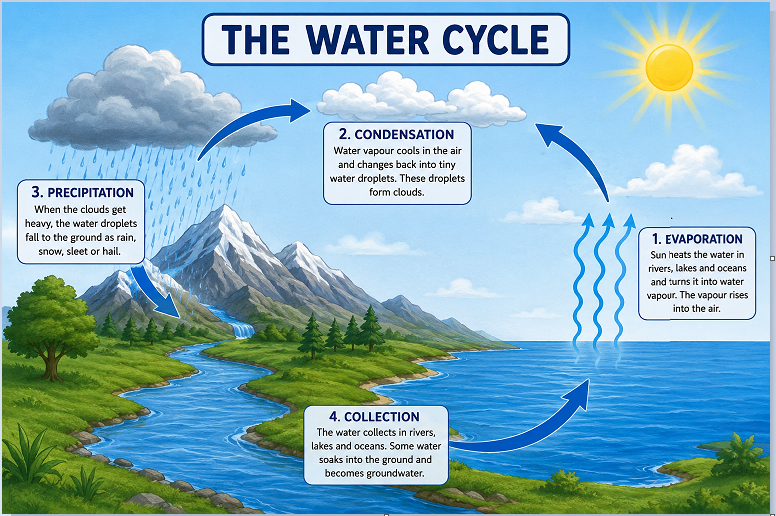
Stages of the Water Cycle
The water cycle has four main stages:
1. Evaporation
Evaporation is the process by which water changes into water vapor due to the heat of the Sun. Water from oceans, rivers, lakes, and ponds evaporates and rises into the atmosphere.
Example: Wet clothes dry faster on a sunny day because water evaporates into the air.
2. Condensation
As water vapor rises higher into the atmosphere, it cools down and changes into tiny water droplets. This process is called condensation.
These tiny droplets gather together to form clouds.
3. Precipitation
When the water droplets in clouds become too heavy, they fall back to the Earth as precipitation.
Precipitation can occur in different forms:
- Rain
- Snow
- Hail
- Sleet
4. Collection
The water that falls on the Earth’s surface collects in rivers, lakes, ponds, oceans, and underground reservoirs. From there, the cycle begins again through evaporation.
Transpiration
Plants also play an important role in the water cycle. They release water vapor from their leaves into the atmosphere. This process is called transpiration.
Transpiration adds moisture to the air and helps maintain the water cycle.
Importance of the Water Cycle
The water cycle is important because it:
- Recycles water naturally.
- Provides fresh water for living organisms.
- Maintains weather and climate patterns.
- Refills rivers, lakes, and groundwater.
- Supports agriculture and plant growth.
- Helps sustain life on Earth.
Simple Water Cycle Flow
Water in oceans, rivers, and lakes → Evaporation → Condensation → Cloud Formation → Precipitation → Collection → Evaporation again
Frequently Asked Questions (FAQs)
What is the water cycle?
The water cycle is the continuous movement of water between the Earth’s surface and the atmosphere.
What are the four main stages of the water cycle?
The four main stages are evaporation, condensation, precipitation, and collection.
What causes evaporation?
The heat energy from the Sun causes evaporation.
What is condensation?
Condensation is the process by which water vapor cools and changes into tiny water droplets.
Why is the water cycle important?
The water cycle recycles water, provides fresh water, and supports all forms of life on Earth.